
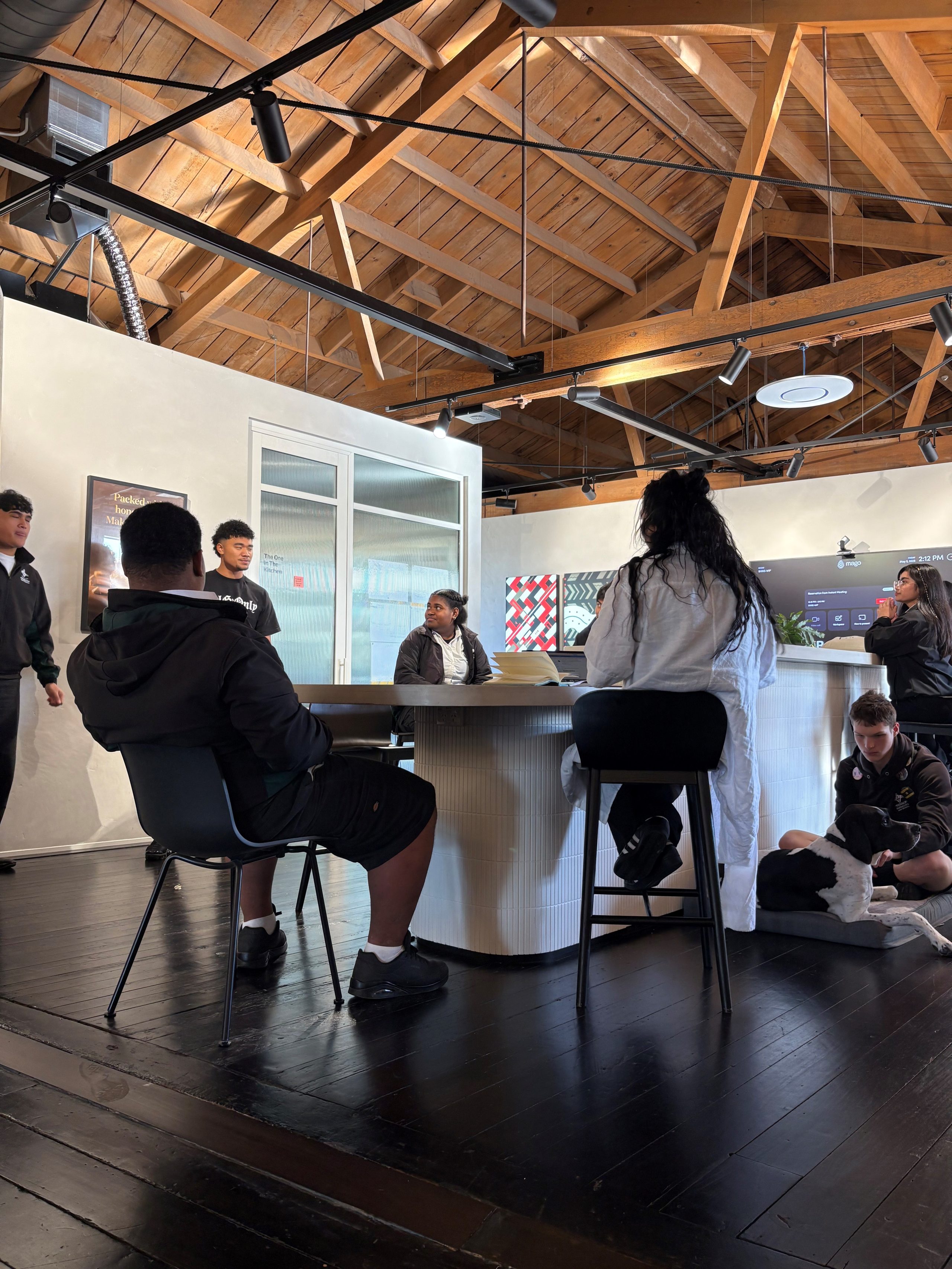
We believe that Entrepreneurship Education is the highest-value investment a school can make in students who will go on to employment, further education, or business ownership. Not because it produces entrepreneurs (though it definitely can do that), but because it builds the mindset, social capital, and practical capability that a meaningful pathway into further education, training or employment requires.
This conviction is at the heart of the Hynds Foundation Business Academy model. It is born of experience building the model and scaling it to new schools.
The communities we work in share a common characteristic: young people have the drive and talent to succeed, but lack the connections, exposure, and belief that come naturally to those who grow up surrounded by business and professional life. Many students do not have a parent, relative, or neighbour in a career that resembles where they might want to go. The social capital that enables ambition is simply absent. This assertion has been offered by our partner principals; it is consistent with philanthropic research from the UK – see ‘Absent Ambition‘.)
Entrepreneurship education brings the business world into a school, creates genuine relationships with students and teachers, builds confidence through doing, and opens pathways the student did not know existed. Understanding for future pathways follows naturally, as an outcome of the broader capability the model creates.
“What was missing for these students was connections to business and careers. Very few of them had family members in a career.” – Salvatore Garguilo, principal at the time of establishing the Manurewa High School Business Academy
The model is built on a clear philosophical position of the Hynds Foundation: to support “New Zealand thriving”. Within the Business Academy model, that translates to every student in a school having access to business learning experiences, because we know every student benefits from the mindset and skills it develops. We wrote more about the ways our model prepares young people for their futures in work for a funder report in 2022.
The Business Academy model does not sit alongside the school. It works to become part of the school’s identity — visible in the culture, embedded in the curriculum, and evident in where students go next.
The Hynds Foundation Business Academy began not as a model but as a relationship. In 2010, John and Léonie Hynds attended Manurewa High School’s 50th anniversary as alumni, and what they found concerned them: a school full of capable students who had almost no connections to the business and professional world. The gap was not aspiration. It was access.
What followed was an evolving, decade-long commitment that moved through three distinct phases before producing a replicable model.
The first investment was to introduce a scholarship programme, with the inaugural recipient a Year 12 student, Ryan King. John says he noticed how Ryan was excited when sharing his experiences in the Young Enterprise Scheme (YES). The following year, Ryan and his classmates formed the Caring and Co Enterprise, producing ‘Unique Drizzle Olive Oil’. With strong mentoring from Lance Hutchison and teaching from Emma O’Riordan, the team won YES National Company of the Year and CEO of the Year, the first time Manurewa High had achieved this.
This single outcome shifted belief. Students and the community saw that they could compete and win in arenas that had previously seemed distant. It created the confidence on which everything was built.
John invited University of Auckland advisers Mark Bentley and Barry Spicer to help shape the initiative, and in those early years they gathered support from alumni and businesses. Law firm Simpson Grierson created a governance framework, and in 2015 the founding documents were signed between the Business Academy charitable trust and the school’s Board of Trustees. Long-standing partnerships with the University of Auckland Business School, EY, ANZ Bank, and Nestlé were formed. The model began to take shape.
New principal Pete Jones fuelled the focus on “people and programmes”. This period produced the model’s most important structural innovations.
Strategic outcomes were formalised across five areas: 1) business learning, 2) alumni and family connection, 3) pathways to employment, tertiary education and business ownership, and 4) effective partnership management. A Balanced Scorecard was introduced to track progress. A Makerspace was established with support from The Southern Initiative, Ministry for Youth Development, Foundation North, Auckland Airport Trust, and the “1968 alumni” group.
The results of this period demonstrate what a mature ecosystem produces. A student Future Problem Solving team — John Chen, Okesene Fatu, Aimee Lew and Aaron Lew — reached the international competition in the United States for three consecutive years, placing fourth in the world in 2018. Taking their place on the world stage would have been impossible without the support of the Business Academy partnership ecosystem. Also on an international stage, Leanne Gibson (executive director) and Yashna Kumar (student leader) were invited to present at the FabLearn Conference at Columbia University, New York, about establishing a Makerspace. It became a reference site for other Auckland high schools.
“Future Problem Solving enabled me to see how technology can positively impact the world. What made our journey possible was the work and belief of incredible individuals and organisations.” — John Chen, Manurewa High leaver 2019, now working in the tech sector in Sydney
Social enterprises emerged from the model: Maara Fresh from the community garden, and Manu Toi from the Makerspace. Alumni like Baue Rubeariki, Ryan King, and Paige Dobbs grew into leadership roles within the Academy’s programmes — the clearest evidence that the ecosystem was sustaining itself.
| 12 years of continuous delivery | 7× Young Enterprise National Finals | 3× Future Problem Solving International appearances | 21 Scholarships awarded to students to the University of Auckland Business School |
As well as students’ achievements, the process of building the academy generated understanding about taking a startup initiative into one that embeds across the school.
Replicating a successful school programme is one of the most difficult challenges in education philanthropy. A conventional assumption is that what worked in one school worked because of the specific people in that school. Our experiences at Manurewa and then Papakura High Schools tests this assumption.
Papakura High is also located in South Auckland and is one of New Zealand’s highest equity index communities, where @15% of 15-to-24 year olds are ‘NEET’ – not in education, employment, or training. The school has strong, committed leadership under principal Simon Craggs, and a desire to innovate in how the school engages students in learning. Those two conditions — community need and school leadership commitment — are the non-negotiables for this model.
Hynds Foundation brought to Papakura, people with a passion for the communities of South Auckland, and a learning system based around:
1) a Makerspace
2) tertiary and business partnerships for outcomes in Business Learning, Pathways to Employment, Further Education and Personal Development, and
3) 12 years of accumulated knowledge about what works and what fails.
In 2024, neither teacher in Papakura’s Business Learning Area had experience with Young Enterprise, very little knowledge of business activities, and no prior experience working with business partners. The ecosystem infrastructure carried the model through its first years.
This is the critical replication insight. A programme that depends on exceptional individual teachers cannot scale. A programme built around an ecosystem is essential to success. To make it work for partners, it’s important that there is flexibility in the People, Time and Resources they can offer. This leads to an advertising agency like Bastion Shine codesigning a Year 12 English curriculum to deliver real-world learning, with business skills and employment pathways baked in.
| The core model | 600 unique student learning experiences delivered across business, further education, personal development and pathways to employment |
| Partners | 20 new business and alumni partners introduced, some supporting the school’s new ProJects and Electives careers-focused learning day. |
| Recognition | Young Enterprise South Auckland Social Enterprise of the Year – ‘Hoodarchy’ – whose community research engaged over 500 young people and directly informed Auckland Council’s Papakura amenities design, resulting in $15,000 of follow-on local board funding |
| Makerspace | Cross-curricular integration achieved across Technology, Art, Science, Māori whaanau, and Pasifika cultural programmes |
| Deloitte | Partnership deepened from initially, introducing its Grow Programme, to introducing a Hackathon, AI for Educators initiative, and teacher participation in Auckland Council’s Pasifika Insights project. |
| Tech Internship | Building on the “Pathways to Employment” programme, and with the support of the Tindall Foundation, we piloted a mentor role who could work with students and partners across Manurewa and Papakura to create a pathway into high-value tech employment. |
“The awards ceremony was a great experience. Seeing and hearing about some of the top Young Enterprise Teams in Auckland was incredibly valuable. We hope we can inspire next year’s entrepreneurs at Papakura to achieve similar if not better results.” — Hoodarchy student
The Makerspace at Papakura is a place connecting across learning areas, and is based on the Unleash model at the University of Auckland. It’s a place for developing entrepreneurship through product design and making. The ‘hominin skulls’”’ project – 3D sculpted models created to support the Science curriculum – has grown into a small social enterprise selling sets to other schools. This mirrors the trajectory of the Manurewa Makerspace, and tells us the ecosystem is working.
Measuring impact is not straightforward. It is easy to track participation of students, teachers, partners and the community. We can follow students who have been highly engaged in the academy to understand their progressions to further education or employment. Once they have moved on from high school, it is harder to stay connected and to provide support. Tertiary education scholarships are one tool that meets this challenge.
At Manurewa High we operated in a school that had one of the largest Trades Academies in the country, as well as academies in Health and Physical Education, and the PTech programme so there were many opportunities for students to transition successfully following a structured pathway. The principal invited us to focus on “students in the middle” who were not on such pathways. We supported the Careers department and curriculum teachers to access learning opportunities, bringing people in and taking students out. Through Makerspace, we had a strong focus on digital skills development.
Partnerships matter for student outcomes. When Year 12 English students go from having never heard of the advertising industry, to discovering the ad agency Bastion Shine as a place where they feel comfortable, we know the model is making the difference needed. When alumni like Deborah Paulo, a 2017 Manurewa leaver working in the tech industry, becomes a board member of the Business Academy Trust, current students can know they can “be what they can see”. These are data points in a longitudinal picture of whether students are accessing pathways that may otherwise have been closed to them.
“I remember the scholarship interview with John and Léonie Hynds like it was yesterday, because it was lifechanging. They helped me to see I am good enough.” — Naotia Atiana, Manurewa High leaver 2014
We track whether business partners return, deepen their involvement and bring other organisations with them. A partner who expands their commitment is evidence of a healthy ecosystem. As you might expect, Hynds Pipes is a long-standing supporter at Manurewa High and Papakura High. The business contributes to the Year 12 Business curriculum as an authentic case study of a large New Zealand company, with a site visit included. Year 13 students can access an internship in a Hynds branch. A two-year cadetship programme provides a pathway for school leavers. A scholarship programme supports Engineering or business pathways.
The Deloitte partnership provides an example of a model that is adaptable to what a business can offer. What began with the introduction of its own entrepreneurship programme, Deloitte Grow, has expanded to an annual Hackathon that include the expertise of Amazon Web Services. Papakura teachers were included in a major Auckland Council community research project that Deloitte facilitated. In 2026, we are piloting an AI for Educators initiative. This trajectory tells us the model is providing genuine value for schools and partner.
Long-standing partnerships at Manurewa – Hynds Pipes, EY, ANZ, and the University of Auckland Business School, each maintained for multiple years – validate the same principle at scale.
We track spread of entrepreneurship education, Makerspace and business partnerships into learning areas. The intention of learning design is to develop teachers’ capability to integrate the methods into their learning plans.
At Papakura, this spread is evident. Art teachers integrate Makerspace into their programmes independently. Hard Materials teachers are embedding Design Thinking into their curriculum. Science, Māori whaanau classes, and Pasifika cultural programmes all use the Makerspace as a regular resource. The Professional Learning Group for Makerspace skills is teacher-led and growing.
When an Art teacher brings her own children into the Makerspace during school holidays, or when the school pools budgets across departments to invest in shared Makerspace equipment, the model has moved from external programme to school infrastructure. That is the outcome the model is designed to produce.
Together, these three measures answer a question more meaningful than any single output metric: is this an add-on programme, or is it change the school embraces and makes its own? At both Manurewa and Papakura, the evidence points clearly to the latter.
The Business Academy model is replicable, but it is not simple. Twelve years of delivery has clarified what is genuinely required, what is desirable, and what will cause the model to fail.
| Principal’s commitment | The principal must actively champion the Academy as a strategic priority — not merely permit it. Without this, business partners sense the ambivalence, teacher collaboration stalls, and the programme stagnates as an extracurricular add-on. |
| Programme manager | A dedicated, experienced manager who sits between the school and the business world is an important structural element. This person holds the partner relationships, carries the curriculum knowledge, builds teaching capability, and provide momentum. |
| Makerspace | The Makerspace gives students a place where making and thinking intersect, attracts partners who want to see innovation in action, and enables cross-curricular integration that a classroom cannot. It also produces social enterprises, which in turn produce real-world business learning. |
| Adaptability through partnership | When the academy starts off in genuine partnership with the school, it allows for adaptability to the school context, ensuring that as partners are introduced, there is trust, understanding and reciprocity. |
The first year of a new Business Academy is primarily about relationship-building and infrastructure, not visible student outcomes. The programme manager spends the majority of her time establishing partner relationships, supporting teachers to build confidence with new methods, activating the Makerspace, or attending to small trust-building moments that precede ecosystem development.
Teacher dependency is the most acute. Departure of a teacher can destabilise an entire programme year.
The physical environment matters. Investment in the physical environment is not always possible, but it is a crucial signal about what the community believes students deserve.
Programme breadth without depth dilutes impact. However, we acknowledge that for some stakeholders, “scale” is understood as “numbers reached”.
Papakura High School is now entering its third year of Business Academy operation. With the arrival of Brendan Lambert, an award-winning YES teacher, the Papakura model can be embedded. The reintroduction of Young Enterprise at Level 3, the addition of Economics and Accounting, and the deepening of the Hynds, Bastion Shine and Deloitte partnerships, all signal a programme with the foundations to sustain itself.
Hynds Foundation is actively developing the framework for introducing the model to further schools. Selection criteria draw directly from what the model requires: a community, a committed principal, and a school with the governance stability and openness to partnerships that the model depends on. As well as exploring a new partner school at the high-school level, we are prototyping a programme for intermediate schools.
The Business Academy is not a programme we deliver to schools. It is a partnership we build with them — one that requires genuine commitment on both sides, and that we approach knowing the first three years are an investment in an ecosystem, not a procurement of outcomes.
This case study was developed with the support of Claude.ai based on our annual reports. Last updated on 2.3.26.